
Storing Peptides Properly: Before and After Reconstitution
Most peptide degradation happens at home, not in transit. The compound arrives intact; what happens over the following weeks decides whether you get what you paid for.
This is the practical version: what to do with a vial, what changes once it is in solution, and what a pre-filled pen changes about all of it.
Lyophilised vs in solution
A lyophilised (freeze-dried) peptide is stable. That is the entire point of the format, the water is removed so there is nothing for the molecule to react with. Sealed and dry, it tolerates a lot.
The moment you reconstitute it, that changes. In solution the peptide is far more sensitive to temperature, light and time. Everything below is really about the second state, not the first.
The four things that degrade peptides
- Heat. The single biggest factor. Room temperature is tolerable briefly; warm is not.
- Light. UV in particular. Keep vials and pens in their carton.
- Agitation. Shaking shears the molecule. Swirl to dissolve, never shake.
- Time in solution. Even stored correctly, a reconstituted peptide has a usable window rather than an indefinite shelf life.
Practical handling
Before reconstitution: a sealed lyophilised vial is fine refrigerated, and tolerates ambient shipping without issue. Long-term, cold and dark.
Reconstituting: introduce bacteriostatic water slowly, running it down the inside wall of the vial rather than jetting it onto the powder. Let it dissolve on its own. If it has not dissolved, swirl gently. Do not shake it into solution.
After reconstitution: refrigerate, keep it dark, and treat the mixing date as the start of a clock. Bacteriostatic water contains a preservative that allows repeated entry into the vial; sterile water does not, which is a meaningful difference if you are drawing more than one dose.
Our Easy Peptide Mixing Guide covers the volume calculations in detail.
What a pre-filled pen changes
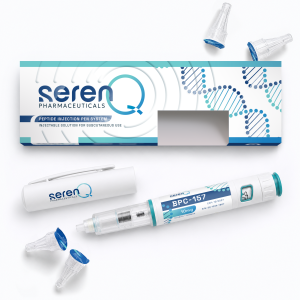
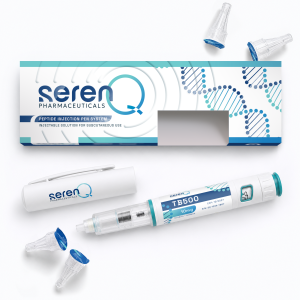
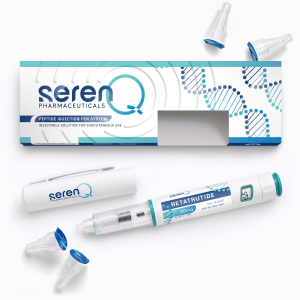
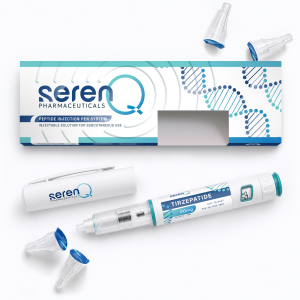
A pre-filled pen arrives already in solution, which removes the reconstitution step and every error that lives in it: no water volume decision, no dilution maths, no introducing contamination during mixing.
What it does not remove is the storage requirement. The peptide is still in solution, so it is still temperature sensitive and still has a usable window. Keep the pen refrigerated, keep it in its carton, and follow the guidance printed on the specific product. The SerenQ range lists this per product.
Travel
The practical problem with travel is not the journey, it is the gap at either end. An insulated pouch with a cool pack handles a day comfortably. What catches people out is leaving a pen in a car or a sunlit room on arrival, a couple of hours of genuine heat does more damage than the whole flight.
Signs something has gone wrong
Cloudiness, visible particulates, discolouration, or a solution that will not clear are all reasons to stop. A correctly reconstituted peptide solution should be clear. If it is not, the answer is not to use it anyway.
Supplied for research purposes only. This article is informational and is not medical advice.
Products covered in this guide
 SerenQ
Related guides
Ready to get started?
Browse our range of pharmaceutical-grade peptides, all third-party tested and verified.
Shop All Products →

💬 Discussion