
GHK-Cu: Skin, Hair and Collagen
GHK-Cu is a copper peptide, and the copper is the point. It is a naturally occurring tripeptide that binds copper ions, and most of the research interest sits around collagen, wound healing and hair follicles.
What it is
GHK is a three-amino-acid sequence found in human plasma. It has a strong affinity for copper(II), and the bound complex, GHK-Cu, is what the research is actually about. Plasma levels decline with age, which is where most of the interest in supplementing it comes from.
Where the research focuses
Collagen and skin. The most studied area. GHK-Cu is associated with collagen and elastin synthesis, which is why it appears in topical skincare as well as injectable form.
Wound repair. Its original identification was in the context of tissue remodelling, and that remains the best-supported area.
Hair. Interest centres on follicle size and the growth phase. This is why it turns up alongside finasteride in hair loss discussions, different mechanisms, sometimes used together.
Injectable vs topical
Topical GHK-Cu is common in cosmetics and is the format with the least handling burden. Injectable is used where systemic rather than local effect is the goal. They are not interchangeable, and the dosing conversation is completely different between them.
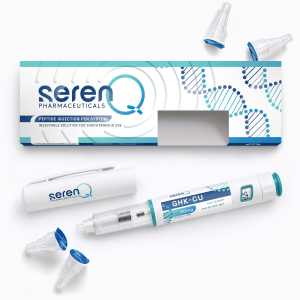
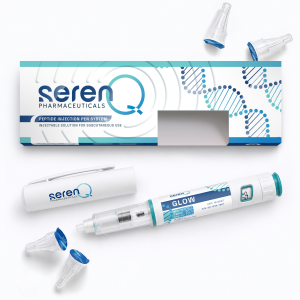
Stocked here as SerenQ GHK-Cu 50mg in a 300 unit pre-filled pen, and inside SerenQ GLOW alongside BPC-157 and TB500.
Why it appears in blends
GHK-Cu covers the skin and collagen side of recovery, where BPC-157 and TB500 cover tissue repair more broadly. That is the logic behind GLOW carrying all three. See BPC-157 and TB500 together for how that pairing works on its own.
The practical caveat with any blend: the ratio is fixed at manufacture. GLOW carries GHK-Cu at 50mg against 10mg each of the other two, so a unit delivers considerably more GHK-Cu than BPC-157. If you want to control that relationship, run the singles.
Handling
Copper peptide solutions carry a characteristic blue tint. That is the copper complex and is expected, not a fault. As with any peptide in solution it is temperature and light sensitive; see storing peptides properly.
Supplied for research purposes only. This article is informational and is not medical advice.
Products covered in this guide
 SerenQ
Related guides
Ready to get started?
Browse our range of pharmaceutical-grade peptides, all third-party tested and verified.
Shop All Products →

💬 Discussion