
BPC-157 and TB500: Why They Are Run Together
BPC-157 and TB500 get run together so often that people treat them as one thing. They are not. They do different jobs, and understanding the split is what tells you whether you need one, the other, or both.
What each one actually is
BPC-157 is a synthetic fragment derived from a protein found in gastric juice. Research interest centres on localised repair: tendon, ligament and gut tissue, and it is typically discussed as the more site-focused of the two.
TB500 is a synthetic version of a fragment of thymosin beta-4, a protein involved in cell migration and new blood vessel formation. Its reported action is more systemic: it is discussed in terms of moving repair machinery to where it is needed rather than acting on one spot.
Why they are paired
The usual argument is that they cover different halves of the same process. TB500 is associated with the migration and circulation side; BPC-157 with the localised rebuilding side. Run together, the reasoning goes, you get both ends rather than one.
That is a coherent rationale, and it is why blends exist. It is not the same as proof that the pairing outperforms either alone: the human research on both compounds is thin, and on the combination thinner still. Worth knowing before you assume the stack is strictly better.
Doses and ratios in practice
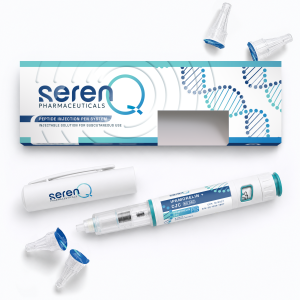
The two are commonly discussed at similar milligram scales, which is why pre-blended products usually carry them at a fixed 1:1 ratio. SerenQ HEAL is BPC-157 5mg with TB500 5mg in a single 200 unit pen; SerenQ GLOW takes the same pairing at 10mg each and adds GHK-Cu 50mg for the skin and collagen side.
If you want to control the ratio yourself, run them separately, BPC-157 10mg and TB500 10mg are stocked as individual pens, and both are available as vials in the healing and recovery range.
Blend or separate?
A blend makes sense if you want the standard pairing at a standard ratio and would rather not manage two products. One pen, one dial, no combining.
Separate makes sense if you want a ratio other than 1:1, if you want to run one for longer than the other, or if you want to establish how you respond to each before combining them. You cannot unmix a blend.
Practical notes
Both are peptides in solution once reconstituted, so both are temperature sensitive and both have a usable window after mixing. A pre-filled pen removes the reconstitution step entirely. See peptide pens vs vials, but does not remove the storage requirement.
If injury recovery is the goal, neither compound replaces the boring parts: load management, sleep and protein intake still do most of the work.
Supplied for research purposes only. This article is informational and is not medical advice.
Products covered in this guide
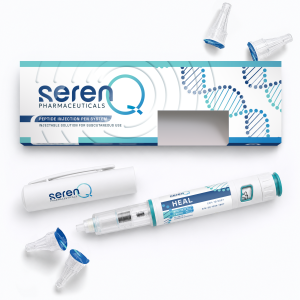 SerenQ Heal 10mg Peptide PenSerenQ Original price was: £75.00.£50.00Current price is: £50.00.
 SerenQ
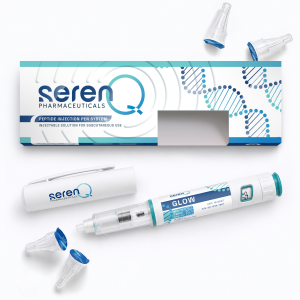 SerenQ Glow Peptide PenSerenQ Original price was: £100.00.£85.00Current price is: £85.00.
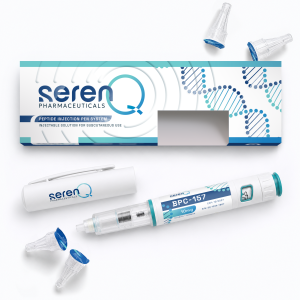 SerenQ BPC-157 10mg Peptide PenSerenQ Original price was: £60.00.£45.00Current price is: £45.00.
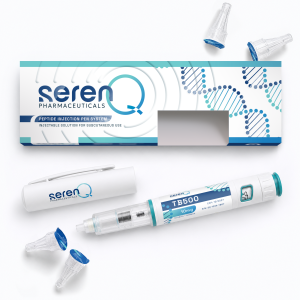 SerenQ TB500 10mg Peptide PenSerenQ Original price was: £70.00.£55.00Current price is: £55.00.
Related guides
Ready to get started?
Browse our range of pharmaceutical-grade peptides, all third-party tested and verified.
Shop All Products →

💬 Discussion