
Peptide Pens vs Vials: What Actually Changes
A pre-filled peptide pen and a lyophilised vial can contain exactly the same compound at exactly the same dose. What changes is everything that happens between the carton arriving and the dose being measured, and that is where most handling errors come from.
This is a practical comparison of the two formats: what each one asks of you, where the mistakes actually happen, and how to read a pen’s dial if you have only ever used a syringe.
The vial workflow, step by step
A lyophilised vial arrives as a dry powder. Before anything can be measured, it has to be reconstituted:
- Work out how much bacteriostatic water to add, based on the mg in the vial and the concentration you want.
- Draw that volume up and introduce it slowly against the glass wall, not directly onto the powder.
- Let it dissolve. Swirl, never shake.
- Convert your intended dose in mg or mcg into units on an insulin syringe, which depends entirely on the dilution you just chose.
- Store the now-liquid vial correctly, and track how long it has been in solution.
None of these steps is difficult in isolation. The problem is that step four depends on step one, so a miscalculation at the start silently propagates into every dose that follows. If you have ever recalculated a dose three times to be sure, that is the format, not you. Our Easy Peptide Mixing Guide walks through the maths properly if you are working with vials.
The pen workflow, step by step
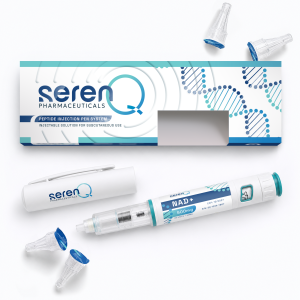
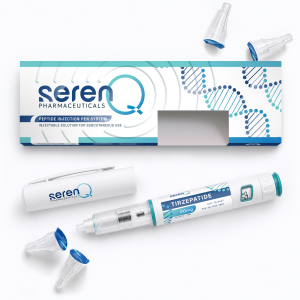
A pre-filled pen arrives with the compound already in solution at a fixed concentration:
- Attach a pen tip.
- Dial the number of units you want.
- Read the number in the window.
- Dispense.
There is no reconstitution, no bacteriostatic water, no drawing up, and no dilution decision to get wrong. The concentration was set at manufacture, so the units on the dial map to a fixed amount of compound every single time.
Where the real difference shows up
Dose consistency. With a vial, your dose accuracy is limited by how precisely you can read a syringe barrel and how accurate your original dilution was. With a pen, the dial is mechanical and repeatable: the same number gives the same amount on day one and day thirty.
Blends. This is the largest practical gap. Running BPC-157 alongside TB500 from vials means two reconstitutions, two dilution calculations, and either two injections or combining them yourself. A pre-blended pen such as SerenQ HEAL holds both at a fixed ratio, so there is nothing to combine and nothing to get wrong. SerenQ GLOW does the same across three compounds.
Travel and storage. A pen is one sealed object with the tips in the same carton. A vial setup is a vial, a water ampoule, syringes, and needles.
Where vials still win. Vials are usually cheaper per mg, and they let you choose your own concentration, which matters if you want a dilution the pen format does not offer. Vials also come in a far wider range of compounds. A pen is a fixed decision made at manufacture; that is exactly why it is simpler, and also why it is less flexible.
How to read a pen dial if you have only used syringes
The unit on a pen dial is not a fixed quantity of compound across products, it depends on the pen’s concentration. A 10mg peptide in a 200 unit pen and a 10mg peptide in a 300 unit pen deliver different amounts per unit.
Every SerenQ product page lists this explicitly: total content in mg, total units in the pen, what a given dial graduation equals, and the amount per single unit. Check that block rather than assuming units carry across between products. On SerenQ BPC-157, for instance, 10mg is spread across a 200 unit pen; on SerenQ Tesamorelin the same 10mg is spread across 300 units. Same milligrams, different units per dose.
Verifying what you have
Whichever format you buy, the label matters. Every pen in the SerenQ range carries a unique serial number and a QR authenticity code that resolves to the manufacturer’s own verification record, so the pen can be checked against SerenQ rather than against a reseller’s assurance. Check it when the carton arrives, not later.
Which format should you choose?
If you are running a single compound, are comfortable with reconstitution maths, and want the lowest cost per mg, vials remain the sensible choice.
If you are running a blend, if you travel, if you have ever second-guessed a dilution, or if you simply want the dose to be the same every time without arithmetic, the pen format removes the steps where those errors occur. That is the entire argument for it, and it is a handling argument rather than a potency one. The compound is the compound.
All products referenced are supplied for research purposes only.
Products covered in this guide
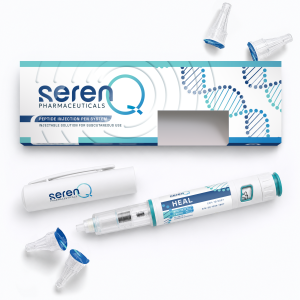 SerenQ Heal 10mg Peptide PenSerenQ Original price was: £75.00.£50.00Current price is: £50.00.
 SerenQ
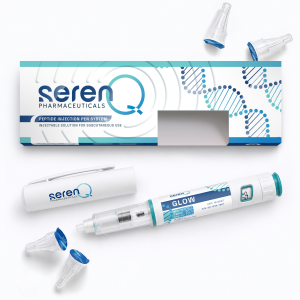 SerenQ Glow Peptide PenSerenQ Original price was: £100.00.£85.00Current price is: £85.00.
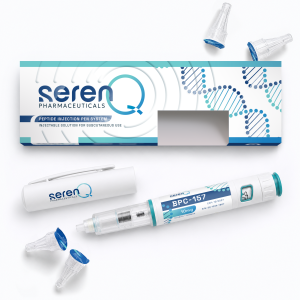 SerenQ BPC-157 10mg Peptide PenSerenQ Original price was: £60.00.£45.00Current price is: £45.00.
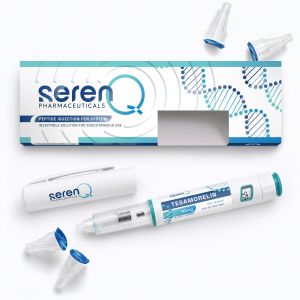 SerenQ Tesamorelin 10mg Peptide PenSerenQ Original price was: £95.00.£65.00Current price is: £65.00.
Related guides
Ready to get started?
Browse our range of pharmaceutical-grade peptides, all third-party tested and verified.
Shop All Products →

💬 Discussion