
How Many Doses Are in a 10mg Peptide Pen
“How many doses in a 10mg pen” has no single answer, and the reason is that a dose is a decision while a pen is a fixed volume. Once you can convert between the two, comparing pens on price becomes straightforward.
The three numbers that matter
Every pen carries three figures, and you need all three:
Total compound. The headline, 10mg, 40mg, 500mg. This is what is dissolved in the cartridge.
Cartridge volume. How much liquid that compound is dissolved in. Usually printed on the carton rather than the pen body.
Units per full dial. How the dial divides that volume into clicks.
Concentration is total compound divided by volume. Per-unit amount is concentration divided by units. Everything else follows from those two sums.
A worked example
Take a 10mg pen holding 1ml of solution, with a dial reading up to 100 units across that 1ml.
Concentration is 10mg per ml. Each unit is one hundredth of a millilitre, so each unit carries 0.1mg. That is 100mcg per click.
Now the question answers itself. If you are using 250mcg, that is 2.5 units, and the pen holds 40 of those. If you are using 500mcg, that is 5 units and the pen holds 20.
Same pen, same 10mg, and the answer to “how many doses” moved by a factor of two purely because the intended amount changed.
Why milligrams alone mislead
This is where price comparisons go wrong. A 40mg pen is not automatically four times the value of a 10mg pen, because the compounds are used at completely different scales.
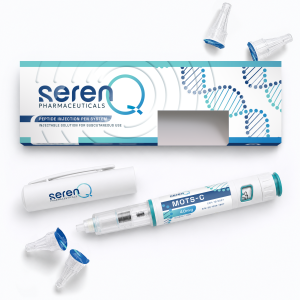
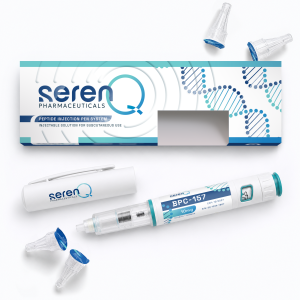
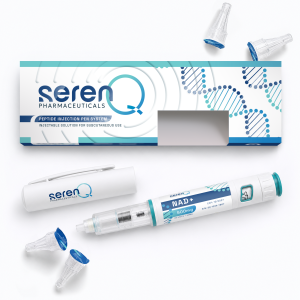
A MOTS-c 40mg pen and a BPC-157 10mg pen are not comparable on milligrams in any meaningful sense, the amounts each is used in are different, so the number of doses each yields is not proportional to the label. The same applies to a NAD+ 500mg pen, where a large headline figure reflects a compound used in far larger amounts, not exceptional value.
The only comparison that holds is cost per dose at the amount you actually intend to use.
Blends need an extra step
On a blend pen the headline figure covers everything in the cartridge combined. A two-compound 10mg blend is not 10mg of either ingredient. It is a split, in whatever ratio it was filled at.
So the per-unit figure you calculate is the per-unit figure for the blend, and each individual compound is a fraction of it. Comparing a blend’s milligrams against a single-compound pen’s is the commonest arithmetic error in the category. Blend pens explained covers why the ratio is fixed.
The number you will not get from arithmetic
Two things reduce the real yield below the theoretical one.
Priming. Each tip change costs a small amount of solution to clear air from the needle. Over a full cartridge that adds up, and it is unavoidable rather than wasteful. See priming a peptide pen.
The end-of-cartridge remainder. Most pens will not dial a full dose out of the last fraction of solution, because there is not enough left to deliver one. That residue is a design consequence, not a short fill.
Budget a little under the theoretical figure and you will not be caught out.
The practical takeaway
Work out your per-unit amount once, for the specific pen in front of you, and write it down. Every subsequent question, how long this lasts, whether that pen is better value, what to dial after switching sizes, resolves from that one number.
For the mechanics of the dial itself, see how to read a peptide pen dial.
Supplied for research purposes only.
Products covered in this guide
 SerenQ
Related guides
Ready to get started?
Browse our range of pharmaceutical-grade peptides, all third-party tested and verified.
Shop All Products →

💬 Discussion