
Tesamorelin: What It Targets and How It Differs From HGH
Tesamorelin is a growth hormone releasing hormone analogue, and its reputation comes from one specific result: visceral fat. That is what separates it from the other GH-adjacent compounds, and it is why people pick it over a general secretagogue.
What it actually is
Tesamorelin is a stabilised analogue of GHRH, the hormone your hypothalamus uses to tell the pituitary to release growth hormone. Native GHRH breaks down in minutes. Tesamorelin is modified to survive long enough to be useful, but it works through the same receptor and the same pathway.
That matters because it means tesamorelin does not add growth hormone from outside. It asks your pituitary for more of your own, which keeps the release pattern closer to normal physiology than an injection of somatropin does. If you want the distinction between those two approaches in full, the HGH kits, pens and secretagogues comparison lays it out.
Why visceral fat keeps coming up
Tesamorelin is the GH-pathway compound with the most specific body-composition research attached to it, and that research centred on visceral adipose tissue, the fat packed around the organs rather than the fat under the skin.
This is a meaningful distinction. Visceral fat is metabolically active and is the compartment most associated with cardiometabolic risk, so a compound with a measurable effect there attracts a different kind of attention than a general fat loss agent. It is also why tesamorelin gets discussed alongside GLP-1 compounds even though the mechanism has nothing in common with them.
How it differs from ipamorelin and CJC-1295
All three raise GH, but not through the same door.
Tesamorelin and CJC-1295 are both GHRH analogues, they act on the GHRH receptor and raise the ceiling of a release.
Ipamorelin is a ghrelin receptor agonist. It presses the trigger rather than raising the ceiling, which is why it is so often paired with a GHRH analogue rather than run alone. That pairing is covered in Ipamorelin and CJC-1295.
So tesamorelin sits on the same side of the mechanism as CJC-1295. The practical difference is that tesamorelin carries the visceral fat research and CJC-1295 does not.
The pen format changes the arithmetic
Tesamorelin has historically been one of the more awkward compounds to handle. Supplied as a lyophilised powder it needs reconstituting, and once in solution it is on a clock. A pre-filled pen removes the mixing step entirely and replaces syringe-drawing with a dial.
The SerenQ Tesamorelin 10mg pen is the range’s version of this. As with every pen in the range, the dial reads in units of volume rather than milligrams of compound: a distinction that trips people up constantly, and one worth understanding before you touch the dial. How to read a peptide pen dial covers the conversion properly.
What to be realistic about
Tesamorelin is not a shortcut around a calorie deficit, and the visceral fat research it rests on was conducted in a specific clinical population rather than in lean, training individuals. Extrapolating from one to the other is exactly the kind of assumption that produces disappointment.
It also shares the general GHRH-analogue caveat: it depends on a pituitary that can respond. Anything that blunts GH release blunts tesamorelin along with it.
Where it fits the range
If the interest is GH pathway support in general, the Ipamorelin + CJC-1295 pen is the more common starting point. If the interest is specifically the visceral compartment, tesamorelin is the compound with the research behind it. If what is actually wanted is growth hormone itself rather than a signal to produce more, that is the HGH pen instead.
All SerenQ pens are stored and handled the same way. See storing peptides properly.
Supplied for research purposes only.
Products covered in this guide
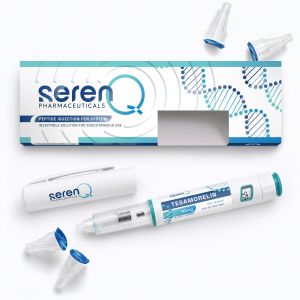 SerenQ Tesamorelin 10mg Peptide PenSerenQ Original price was: £95.00.£65.00Current price is: £65.00.
 SerenQ
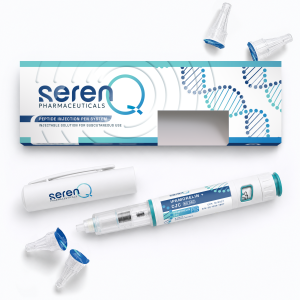 SerenQ Ipamorelin + CJC 1295 (No Dac) Peptide PenSerenQ Original price was: £75.00.£55.00Current price is: £55.00.
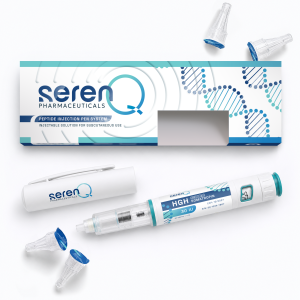 SerenQ HGH 30iu Peptide PenSerenQ Original price was: £95.00.£60.00Current price is: £60.00.
Related guides
Ready to get started?
Browse our range of pharmaceutical-grade peptides, all third-party tested and verified.
Shop All Products →

💬 Discussion